We source recycled ABS pellets in China by grade — from colour-managed post-consumer grades to bulk natural and grey-white pellets — and match the grade to your colour reference and target price.
Send us a photo or sample of the colour you accept, the monthly quantity and your target price. We come back with the grades that fit, lot photos and a landed quote. → Request recycled ABS grades
Some recycled ABS costs more than virgin ABS. When we asked Chinese recyclers for natural-colour recycled ABS pellets in October 2026, the first grades offered were colour-managed, certified post-consumer grades, and their prices sat at or above what virgin ABS was trading for in China at the time. The cheapest recycled ABS and the most expensive one can start from the same kind of scrap. What separates them is what the buyer needs to prove and how tightly the colour is held from lot to lot.
Nami Tech Solutions (NTS) sources recycled ABS pellets from recyclers and compounders in China for buyers in Korea and beyond. We sort the market by grade, match the grade to the colour reference and price the buyer gives us, collect lot photos and documents, and arrange samples before the first container. This article sets out how the grades work and which rules sit behind the price differences.
Disclaimer: This article is general information, not legal, customs or regulatory advice. Our reading of EU, Japanese and Korean rules is analysis; confirm classification and duty treatment with a licensed customs broker and compliance claims with your certification body. Status as of October 30, 2026.
One Word, Two Markets
"Recycled ABS" covers two markets that barely talk to each other.
The first is compliance-driven. The buyer, usually an electronics brand, an automotive supplier or someone selling to them, has to show that a part contains a stated share of recycled plastic. That buyer needs post-consumer origin, a chain-of-custody certificate and colour that holds from lot to lot, because the part is often sold unpainted. Recyclers who serve this market typically sort white appliance and IT housings into narrow colour streams and sell to a specification. These are the grades that can cost more than virgin.
The second is cost-driven. The buyer is a compounder or moulder that wants a cheaper feedstock than virgin and does not need to prove anything about its origin. Here recycled ABS trades as a commodity: by colour, by impact rating and by the scrap it came from. Lot-to-lot colour moves more, documents are thinner and the price follows the colour class.
The two markets use the same name for different products. A buyer who asks for "recycled ABS, natural colour" without saying which market they are in will be quoted in whichever market the supplier knows best. That is how we received certified-grade prices for a cost-driven enquiry.
How Chinese Recyclers Grade ABS
There is no single grading system. China has a national standard for recycled ABS pellets, GB/T 40006.5-2021 (Plastics — Recycled plastics — Part 5: ABS materials, issued October 11, 2021, in force May 1, 2022). It covers pellets made by physical recycling (crushing, washing, melting and pelletising) of industrial or household ABS waste. Day to day, though, the commodity market names its grades in its own way. Public price sheets published by Chinese recycling-market sites list recycled ABS pellets under names like these:
Flame-retardant and non-compliant streams are separate products, not a quality step
Two things in those sheets matter for an import buyer. First, the prices are quoted ex-tax for the domestic market, so an export price is not the sheet price plus freight. Second, the colour names are not measurements. One recycler's "cream" can be another's "natural", and a lot called "grey-white" can be bright enough to pass a buyer who rejected a darker lot under the same name.
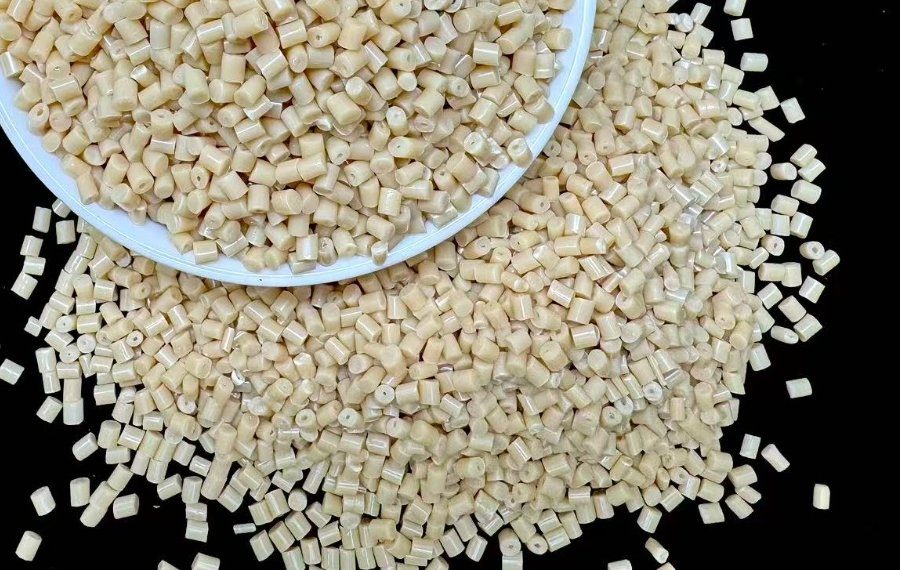
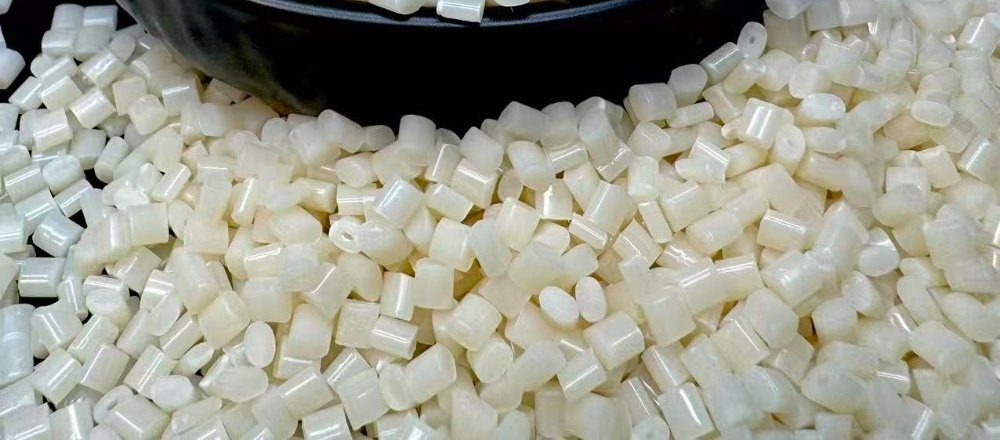
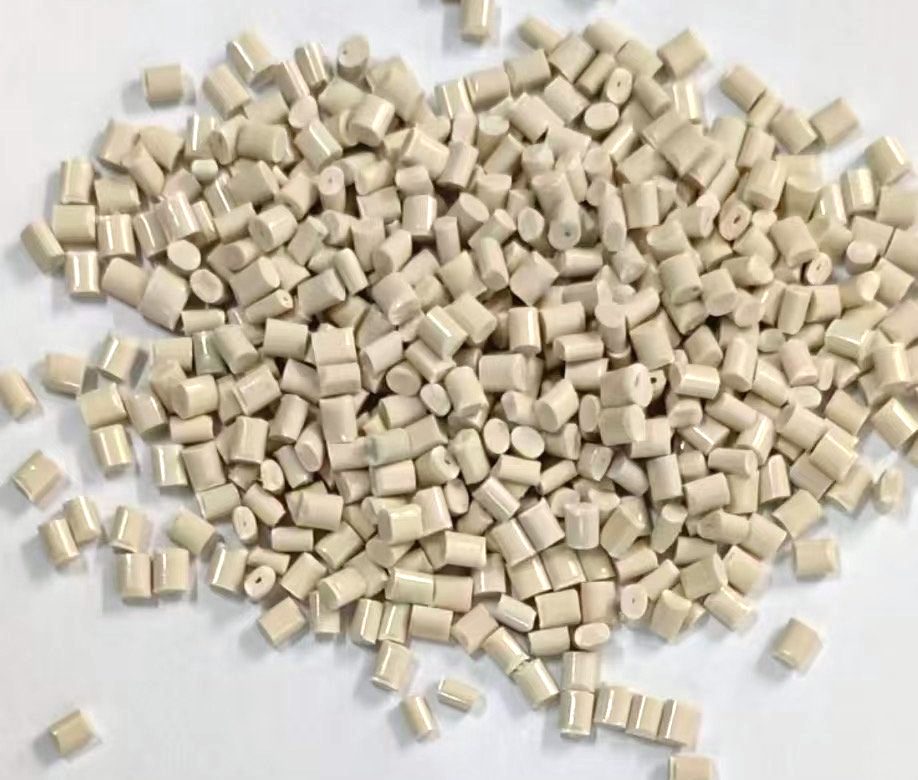
The pellets below show the range we are offered. They are lot photos supplied by producers, taken under different lighting and backgrounds, so they show the colour range and not an inspection standard.
Colour-managed post-consumer grade, cream. Lot photo supplied by a producer; colour varies by lot and lighting.
Colour-managed post-consumer grade, near-white. The whiter the target, the narrower the scrap stream and the higher the price.
Bulk natural grade without certification, photographed on white paper — the condition we ask every supplier to use.
Get analyses like this in your inbox
No spam. Unsubscribe anytime.
PCR and PIR: Which Recycled Content Counts
Two terms decide what a recycled grade can be used for.
Post-industrial recycled (PIR) content, also called pre-consumer, comes from manufacturing scrap that never reached a user: runners, purge, off-spec parts. ISO 14021 counts it as recycled only when it is diverted from the waste stream. It excludes rework and regrind that the same process can take back. PIR is usually clean and consistent in colour, because one factory's scrap is one material.
Post-consumer recycled (PCR) content comes from products that were used and thrown away: televisions, printers, vacuum cleaners, car parts. It is mixed, aged and harder to sort into a narrow colour, which is why a colour-managed PCR grade takes more work than a PIR grade of the same colour.
The distinction is not academic. A certificate that a lot is post-consumer, issued under a chain-of-custody scheme such as the Global Recycled Standard (GRS), is what a compliance buyer pays for. A cost-driven buyer pays nothing for it and should not be quoted for it. When a supplier asks "do you need a transaction certificate?", the answer moves the price.
The Rules Behind the Premium
Mandatory recycled content for durable plastic parts is arriving through cars first, and outside Korea.
Jurisdiction
Rule
What it requires
Does it reach recycled ABS from China?
European Union
End-of-Life Vehicles Regulation (EU) 2026/1738, published in the Official Journal on July 24, 2026, in force August 13, 2026
New vehicle types approved from September 1, 2032 must contain at least 15% recycled plastic, and from September 1, 2036 at least 25%. At least 20% of that recycled share must come from end-of-life vehicles
Only post-consumer material counts. Recyclate from outside the EU cannot count until August 14, 2030, and after that only under equivalence conditions and audits
Japan
Targets announced by the Ministry of Economy, Trade and Industry, as reported in October 2026
Supply of recycled plastic for cars to grow from 21,000 tonnes a year in 2030 to 200,000 tonnes a year after 2041; a carmaker targets at least 30% recycled material by weight on average in new models launched after 2030
Targets, not a mandate. Japan's waste-plastic recycled-distribution ratio was 4.7% in 2024, so supply, not demand, is the open question
Korea
Recycled-content obligation (재생원료 사용의무), applied in full from January 1, 2026
10% recycled content in PET beverage bottles in 2026, 30% by 2030, for producers above a tonnage threshold
PET bottles only. No recycled-content obligation applies to ABS parts
Two conclusions follow. In Korea, demand for recycled ABS is a cost decision, not a compliance one, so the Korean buyer is mostly in the second market — unless the parts go into EU- or Japan-bound vehicle programmes or to a brand with its own recycled-content target. And the premium grades are priced for buyers abroad who must prove post-consumer origin — the EU automotive chain (requirements from 2032, with non-EU recyclate eligible only from August 2030), Japanese carmakers, and electronics brands with their own recycled-content targets. A Korean moulder paying that premium for parts that do not need the certificate is paying for paperwork.
Classification: One Customs Code for Virgin and Recycled
Recycled ABS pellets are classified with virgin ABS. HS Chapter 39, Note 7, says heading 39.15 (waste, parings and scrap) "does not apply to waste, parings and scrap of a single thermoplastic material, transformed into primary forms (headings 3901 to 3914)." Pellets made from ABS scrap go to 3903.30, the same subheading as virgin ABS, and Korea's 10-digit code 3903.30-0000 has no recycled sub-line. Two consequences follow:
The trade statistics cannot separate recycled from virgin. Korean import data for 3903.30 mix both, so the average import price says nothing about what recycled ABS costs.
Pellets are a product, flakes are a problem. Korea has banned new imports of plastic waste since June 18, 2022, with a few exceptions. Crushed flake or regrind can be treated as waste rather than as a primary form, depending on how it is described at customs. Buy pellets, and keep the supplier's description and the commercial invoice consistent with that.
Under the Korea–China FTA the 2026 rate for 3903.30-0000 is 0%, against 6.5% without a certificate of origin. Small recyclers often cannot export in their own name and sell through an export agent, so who issues the certificate of origin has to be settled before the price is.
Colour Is the Specification Nobody Writes
In a cost-driven enquiry, colour is usually the only requirement, and it is the one most often left vague. "Natural", "ivory" and "off-white" are names, not numbers. Four habits keep a colour requirement enforceable:
Send a reference, not a word. A physical limit sample (the darkest acceptable lot) is best. A photo works only if every supplier photographs on the same white paper under similar light. Photos on black or coloured backgrounds, like several above, cannot be compared with each other.
Compare pellets with pellets. A moulded plaque of the same material looks darker and more saturated than loose pellets. Judge pellets against the pellet reference and the moulded part against a moulded reference.
Ask for L*, a*, b* on the certificate. Colour-managed grades measure them every lot. Bulk grades often do not, and then the sample decides.
Say what "bad" looks like. A greyish, dull lot and a yellowish lot fail for different reasons. A buyer who tolerates slight yellowing but rejects grey should say so, because the cheaper grades often fail on exactly one of the two. Say how many black specks you accept, too.
We have put lot photos from six current offers side by side, from a certified near-white grade to a bulk natural grade, with their relative price levels, on our recycled ABS page. One of them shows point 1 in practice: shot underexposed under warm light, it made the pellets look darker and greyer than they were, until we corrected it against the white paper they were lying on.
What a Buyer Should Settle Before the First Order
Which market you are in. If you do not need to prove recycled content, say so in the first message. It keeps certified premiums out of the quote.
The colour reference and what fails. A limit sample or a white-paper photo, plus the failure mode you care about.
Whether any property matters. If melt flow or impact matters to your moulding, give the window. If nothing matters but colour, say that too, because then the lowest impact class is available.
Pellets, not flakes, and the HS description that goes with them.
The exporter of record and the certificate of origin — factory or agent, and who issues the FTA certificate.
Sample before container. Evaluate a sample from the lot that will ship, against the same reference, before payment terms start. Our sample-evaluation protocol sets out what a sample has to show.
What This Page Does Not Say
Some of what makes recycled ABS sourcing work is specific enough that we share it directly rather than in public: which producers hold which colour streams, current prices by grade and port, which grades passed which buyers' colour references, and lot certificates. Ask us, and we answer for your colour, quantity and destination.
Need recycled ABS at a target price without sorting the market yourself? NTS sources recycled ABS pellets from recyclers and compounders in China, from colour-managed post-consumer grades with chain-of-custody documents to bulk natural and grey-white grades. We match the grade to your colour reference and target price, collect lot photos and documents, arrange samples, and coordinate the shipment and the certificate of origin. Write to [email protected] or use the inquiry form with a photo or sample of the colour you accept, the monthly quantity, the target price and whether you need recycled-content certification. Grade descriptions are on our recycled ABS page.
Frequently Asked Questions
Is recycled ABS always cheaper than virgin ABS?
No. Bulk commodity grades sold by colour class are cheaper than virgin. Colour-managed post-consumer grades with chain-of-custody certificates can cost as much as virgin or more, because they serve buyers who must prove recycled content.
What is the difference between PCR and PIR?
Post-consumer recycled (PCR) material comes from products that were used and discarded. Post-industrial (PIR, or pre-consumer) material comes from manufacturing scrap diverted from the waste stream. Under ISO 14021, rework and regrind that the same process can take back do not count. Rules such as the EU End-of-Life Vehicles Regulation count only post-consumer material.
Can recycled ABS from China count toward the EU car recycled-content target?
Not before August 14, 2030. Under Regulation (EU) 2026/1738, recyclate from outside the EU cannot count until then, and after that only under equivalence conditions and audits.
Does Korea require recycled content in ABS parts?
No. Korea's recycled-content obligation, applied in full from January 1, 2026, covers PET beverage bottles. Korean demand for recycled ABS is driven by cost.
What HS code do recycled ABS pellets use?
3903.30, the same as virgin ABS, because HS Chapter 39, Note 7, keeps single-polymer scrap transformed into primary forms out of heading 39.15. In Korea the code is 3903.30-0000, with no separate line for recycled material.
References (Public Sources)
Chinese national standard GB/T 40006.5-2021, Plastics — Recycled plastics — Part 5: Acrylonitrile-butadiene-styrene (ABS) materials, issued October 11, 2021, effective May 1, 2022 (standard summary via a Chinese testing-laboratory standards listing).
ISO 14021, Environmental labels and declarations — Self-declared environmental claims, definition of pre-consumer material (as quoted by CLEPA).
Council of the European Union, press release on the formal adoption of the End-of-Life Vehicles Regulation, June 29, 2026; European Commission, news item on the regulation's entry into force, August 12, 2026; ICIS, reports on Regulation (EU) 2026/1738, July 27, 2026.
Asia Economy (아시아경제), report on Japan's recycled-plastic targets for cars and appliances, October 14, 2026.
Shin & Kim, newsletter on Korea's recycled-content obligation for PET bottles, December 19, 2025; Newspim, report on the Korean government's plastic-reduction plan, April 28, 2026.
Han River Basin Environmental Office (한강유역환경청), press release on the ban on new imports of plastic and textile waste, June 17, 2022.
World Customs Organization Harmonized System, Chapter 39, Note 7; Korea Customs Service tariff schedule for 3903.30-0000 (2026 rates).
Public recycled ABS/PS price sheets published by a Chinese recycling-market information site, June 20, 2025 and April 8, 2026 (grade naming only).