
Green silicon carbide, classified into precision micro-powder cuts. Purity barely moves across the series — particle size is what separates the grades and their uses, from sub-micron sintering feedstock and polishing slurry up to wire-saw and coarse-lapping cuts. The one trap to clear before comparing quotations is the size designation: JIS, FEPA and the Chinese W grade (GB/T 2481.2) put similar digits on materially different powders, so read the standard, not the bare number — the full list is in ten checkpoints for buying SiC powder.
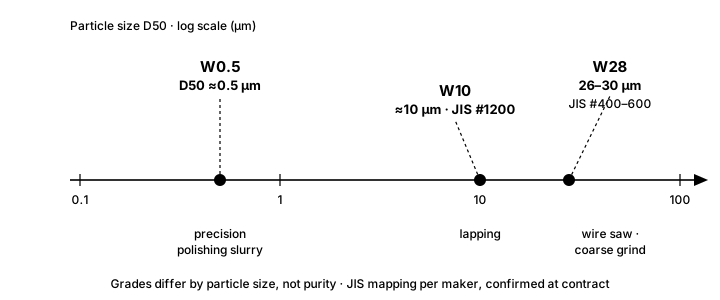
The grades separate by particle size, not purity — and the W number is a GB/T basic-grain bound, not a D50, with the JIS mapping confirmed per maker at contract.
Grades
| SKU | Grade | Typical | Application |
|---|---|---|---|
| NTS-GC-W05 | W0.5 (D50 ≈0.5 µm) | SiC ≥99%, ultrafine, jet-milled | Ceramic sintering feedstock, precision polishing slurry |
| NTS-GC-W10 | W10 (D50 ≈10 µm, JIS #1200 band) | SiC ≥99% | Lapping, precision polishing |
| NTS-GC-W28 | W28 (D50 26–30 µm, JIS #400–600 band) | SiC ≥98.5%+ | Wire-saw slurry, coarse lapping |
Other W grades from W1 to W63 on request. Packed in 25 kg bags; moisture-barrier packing (aluminium laminate with desiccant) for sub-micron cuts.
NTS-GC-W05 — W0.5 ultrafine
The sub-micron, sintering-active cut, D50 around 0.5 µm. At this size the number depends heavily on dispersion during measurement, so the COA states the method and dispersion conditions, not just the D50.
NTS-GC-W10 — W10 lapping grade
D50 around 10 µm (JIS #1200 band), the workhorse for lapping and precision polishing. We report D10 / D50 / D90 and top-size per lot, because an oversize tail scratches whatever the median says.
NTS-GC-W28 — W28 coarse cut
D50 26–30 µm across the JIS #400–600 band, for wire-saw slurry and rough lapping. The coarser duty relaxes purity slightly (SiC ≥98.5%+) but not the distribution: span and top-size stay on the COA alongside the median.
What we verify
- Iron reported as the element (Fe), with the Fe₂O₃ conversion shown
- Trace metals — Fe, Ti, Al, Ca, Mg, Na, K, B — by ICP, with the detection limit stated
- Particle size by ISO 13320 laser diffraction, method and dispersion named
- Magnetic content per lot — the early warning on both Fe and Ti