
Particle size decides which yttrium oxide you need before purity does. The submicron grade (0.5–1 µm) sinters readily — transparent ceramics, phosphors, zirconia-stabilization doping; the 3–5 µm grade flows and packs — melt, single-crystal and coating feedstock. Two lots at the same purity are different products if they sit on opposite sides of that line, so choose the grade first: sintering or doping takes NTS-Y-07F, melt/crystal/coating takes NTS-Y-4M, plasma-spray takes the granulated NTS-Y-SP, research-scale takes NTS-Y-NANO. Yttrium is on China's medium-and-heavy rare-earth control list, so every shipment travels on an export licence with an end-user certificate, which we run as part of supply — how the regime has behaved since it took effect is in our analysis of China's rare-earth controls, and which licence clock governs a shipment is in the licence-deadline guide.
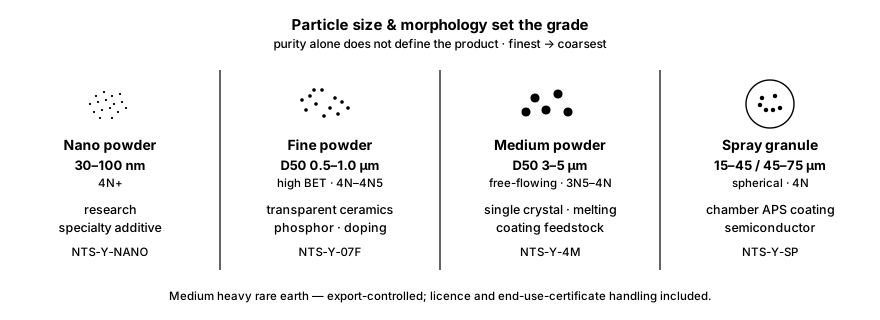
Dot density stands in for fineness — the fine grade's reactivity is exactly what makes it the wrong feed for melting. These grades share roughly one purity band (3N5–4N5), so what you actually select on is surface area and morphology, not purity.
Grades
| SKU | Grade | Typical | Application |
|---|---|---|---|
| NTS-Y-07F | Fine 0.5–1.0 µm ("0.7 µm class") | 4N–4N5 D50 0.5–1.0 µm high BET | Transparent ceramics, phosphors, zirconia stabilization doping, sintering additive |
| NTS-Y-4M | Mid 3–5 µm ("4 µm class") | 3N5–4N D50 3–5 µm | Single-crystal and melt feedstock, coating feedstock |
| NTS-Y-SP | Thermal-spray granules | 4N 15–45 / 45–75 µm spherical granules | APS coating of semiconductor chamber parts |
| NTS-Y-NANO | Nano | 4N+ 30–100 nm | Research, specialty additives |
NTS-Y-07F — fine powder, 0.5–1.0 µm
The sintering-active grade, 4N–4N5 at D50 0.5–1.0 µm with high BET, for work where the powder reacts or densifies — transparent ceramics, phosphor synthesis, zirconia doping, sintering-additive service. Its reactivity is exactly why it handles poorly in melt charging, which is what the 4 µm class is for.
NTS-Y-4M — mid powder, 3–5 µm
3N5–4N at D50 3–5 µm, trading sintering activity for the flowability and packing density that melt, single-crystal and coating feedstock require. If your process consumes yttria by melting or spraying rather than solid-state reaction, start here.
NTS-Y-SP — thermal-spray granules
Spherical granules in 15–45 and 45–75 µm cuts at 4N, for atmospheric plasma spray of semiconductor chamber components. Specified by granule cut, not primary particle size, because morphology governs feed behaviour in the gun.
NTS-Y-NANO — nano powder
4N+ at 30–100 nm, for research programmes and specialty-additive work where the submicron grade is still too coarse. Supplied at development quantities.